On January 11th, the International Court of Justice (ICJ) began the public-hearing of South Africa’s genocide case against Israel. While there is little chance that the court’s ruling will force Israel to stop the war in Gaza, the United Nations system is equally on trial and the whole world is watching.
Historically, the International Judicial system has mostly been about the International Criminal Court (ICC) indicting current and former African leaders on charges of crimes against humanity and abuse of power. This led many African countries to withdraw from such a system and accuse it of bias and selective targeting of Africans. Now, let it be known that some of those indicted people had committed awful crimes and had to face justice. However, one could not ignore that the Court had a particular agenda for Africa. This itself is rooted in the idea of displaying the Collective West as morally superior to the Global South.
Now, ICC’s sister court, the ICJ, is experiencing an unprecedented phenomenon. South Africa is accusing Israel of committing genocide against Palestinians in Gaza. This is based on Israel’s collective punishment strategies of indiscriminate bombing that targets civilians, children, and health centers, expulsion and displacement of Palestinians from their homes, and the rhetoric from some of the government members that is symbolic of the intent to erase Palestinians from Gaza. Of course, Israel defended its campaign as a self-defense effort against Hamas.
This is a case that has brought so much scrutiny on the Court. Everyone is waiting to see how it will handle the overwhelming accusations and evidence against Israel and its biggest ally, the United States. Given the support Israel has received from the West and that South Africa has received from the rest of the world, it also feels like a trial of whether the court, and the United Nations system by extension, can truly flex its international law tenets and principles on a country backed and allied deeply to the West.
South Africa presents a strong case. It does not need to prove right away that Israel is committing a genocide. It simply needs to convince the panel of judges that there is a plausibility of genocide being committed and that the court needs to take provisional measures in line with the Genocide Convention.
The plight of Palestinians has been ongoing for decades, but it seems that the majority of the world is finally waking up to their call. The support for Palestine has reached the walls of power and it is shaking the current “human rights-based” order led by the Western World. That means something. The formal calls by other countries for an independent, sovereign state of Palestine are increasing day by day. The struggle for Palestine’s self-determination will be long and complex, but it is gaining momentum.
-

-

The defending champions opened their 2024 AFCON campaign with a cruising 3-0 victory against Gambia, thus cementing that they won’t be easily dethroned.
Despite boasting the experience and talents of the members of the 2021 AFCON winning squad, this is a Senegal team with an undeniable freshness. Young players like Pape Gueye, Pape Sarr, Nicolas Jackson, and co will look to play a more vital role and mark this as their tournament. In fact, that is the major requisite for the Teranga Lions to reclaim glory.
The members of the old guard, such as Idrissa Gana Gueye and Cheikhou Kouyaté will undoubtedly be content with a place on the bench and playing more of mentoring role to their teammates. On the other hand, the starting core of Sadio Mane, Edouard Mendy, and Kalidou Koulibaly have all grown older and moved to a less competitive league. This is a massive opportunity for the young core and it seems like they are going to seize it.
Senegal has been the most impressive team in a tournament characterized by major upsets so far. Nigeria, Ghana, Cameroon, Egypt, and Algeria have all failed to win their opening matches. It’s too early to count everyone else out, but Senegal is definitely justifying its label of defending champions and one of the tournament favorites. -

The 34th edition of the Africa Cup of Nations kicks off on Saturday, January 13th, 2024, in Ivory Coast and the stage is set for the Super Eagles to finally fly again.
No doubt; this competition boasts massive talents from all the 24 participating national teams. The defending Champions, Senegal, with their prolific captain, Sadio Mané, will be ready to mount a serious title defense. Morocco will be ready to prove themselves again as arguably the best team on the continent after their heroic run at the 2022 World Cup in Qatar. Meanwhile, the old powerhouses of Ghana, Cameroon, Egypt, Algeria, and the hosts, Côte d’Ivoire, will be represented by top talents from the best leagues in the world and ready to stake their claim for continental glory.
However, no team seems to be better well-positioned to take home the winner’s medal than Nigeria. They will be led by the reigning African Player of the Year and Serie A topscorer, Victor Osimhen. The goal-machine will be supported in attack with a solid cast from the same league, including AC Milan and Atalanta sensations, Samuel Chukwueze and Ademola Lookman. Regardless of the surprises of the tournament, we should at least expect Nigeria to entertain and score tons of goals.
A decade ago when Nigeria won the AFCON, they boasted talents like Vincent Enyeama, Ahmed Musa, John Obi Mikel, Victor Moses, and others. There is no doubt that the current version of the Super Eagles have enough talent and hunger to fly the green and white colors up high again.
There have been major surprises in this tournament in the past. There will be this time around as well. Despite a few significant absences, I’m still riding with Osimhen and the Super Eagles. -

No doubt, the African continent is still grappling with the colonial legacies of European rule. However, none has proven to be as influential in the political and security life on the continent as the artificial nation-state.
When European leaders gathered in the 1884 Berlin Conference to partition the land, they drew the map of Africa from their desks in Germany with no knowledge of the continent and its people. This created artificial states that divided families, cultures, and civilizations across the new borders. With the focus on avoiding resource competition among European countries, the colonial projects further exacerbated the splits of African communities.
For instance, in the horn of Africa, they divided the Somali people across territories under the French, British, and Italian. In light of the independence movements in the second half of the 20th century, most countries inherited the colonial borders, and thus their resulting ethnic and cultural fragmentations. This has created economic and political systems built on ethnic differences, where those in power tend to marginalize and even repress minority ethnic groups.
Such is the story of Sudan and South Sudan, Somalia and Somaliland, English and French-speaking parts in Cameroon, and so forth. In these cases where populations are divided across ethnic lines, the nation-states have failed to cater to the needs of all their people. Instead, they have adopted the political systems that have triggered persistent insurgencies, political conflicts, and human rights violations.
Robert Jackson and Carl Rosberg explain state weakness in Africa from the origin of the state formation on the continent. Unlike most of the nation-states across the world, African states derive their legitimacy, not from their people, but from international institutions like the United Nations. The latter is set on maintaining the current geopolitical composition of the continent regardless of the apparent shortcomings of the current system, in several countries, to fulfill the foundational role of the state: security for its people.
That is why in the above mentioned countries, the nation-state is the most influential tool in neocolonialism. It excludes significant portions of the population from the political life of the country and sharing in its economic resources. Political elites know that they can get away with only catering to their ethnic groups, and not the entire population.
This begs the question whether balkanization is truly the long-lasting solution to peace and stability in these countries. In 2007, South Sudan officially became independent from Sudan. Somaliland is in the same struggle with Somalia. Similar discourses have started in eastern DRC. More to discuss in part II. -

From Pan-African Review, authored by Soha Benchekroun

What if resistance in the face of ongoing genocide in Gaza were the ultimate decolonial struggle of the “Global South”, now a vital counterweight to declining Western domination?
Neither more nor less than an anti-colonial struggle
Despite the relentless efforts of Western media propaganda since October 7 to confuse oppressor and oppressed, as has historically been the case on the Palestinian question, the truth has finally got the upper hand. The unspeakable atrocities and injustices suffered by the Palestinian people this last month, and especially over the past 75 years, have been exposed and recalled through social media among others, but also – once again – the flagrant hypocrisy of Western-style “human rights”. The world watches in dismay, wondering in the name of which humanity certain ruling elites can come to “unconditionally” support the mass crimes perpetrated against the Palestinians.
An essential point evidenced by the current war, even for a public opinion that is relatively new to the subject, is that this “conflict”, deliberately described by the Western media as a complex and confused situation, is none other than a relationship between a colonizer and the colonized; the Palestinian people being in an anti-colonial struggle for their freedom and their most fundamental rights. Let’s not forget that these rights are flouted every day by the occupying Israeli authorities, in violation of international law, both in Gaza and in the West Bank, where Hamas, presented by the same media as responsible for the misfortune befalling the Palestinians, does not govern.
The elements intrinsic to the colonial system, namely exploitation, plunder and violence, are to be found in this reality. In this case, a system imposing an apartheid regime, carrying out a project of ethnic cleansing and waging a veritable media war in an attempt to propagate misleading narratives and erroneous readings of history.
Let’s stress, however, that media ploys to have people hate the oppressed and love the oppressors, as in a famous Malcolm X quote, are clearly having trouble working this time. This is reflected in the “Not in my name” movement of Jews, including Holocaust survivors and their descendants, refusing any association with the Zionist political project and the ongoing massacre, or the political declarations – admittedly very rare in the West – of some leaders, notably Irish and Australian, who have led an exemplary principled defense of Palestinian rights. But also, the ordinary citizen who is speaking out, in all conscience, through huge mobilizations in the streets, universities or on social networks, to condemn the complicity of their leaders, to call for the siege on Gaza to be lifted, and above all to demand an immediate ceasefire.
Western-style violence and selective humanity
Some geopolitical analyses speak of the possibility of a regional conflict with disastrous consequences. Are we again facing a large-scale conflict where everyone stands to lose, on the back of Western economic and political interests?
Against this backdrop, we might ask ourselves one question when analyzing, even from a distance, Western interventionism over the last two decades, whether by France in West Africa, or the wars waged by NATO in Afghanistan, Iraq, Libya or Syria, to name but a few: how many more wars must be fought and lost by these powers in the name of so-called “Western values”? How many once-prosperous countries have to be wiped out, to then come and describe these interventions as “mistakes“? And above all, what is the West fighting against? One thing is certain: it has always fought for access to resources for it to establish its economic and political hegemony, systematically resorting to violence in doing so. From the genocide of the first peoples of America, to the barbaric wars waged in Europe as recently as the last century, and on to the ruthless wars of colonization and proxy wars.
To the violence must be added another common trait of leading Western governments, namely the selective humanity which they have blatantly displayed on this occasion, earning themselves a thunder of criticism from various observers and decision-makers, especially from the South, which is united in denouncing the “double standards”. Indeed, the same top leaders, media and international organizations who condemned the war in Ukraine with all their might, preferred to remain silent, take very timid positions on the tragedy in Gaza, or worse, renew their support for war crimes. This asymmetry is felt at every level, since in France, pro-Palestinian demonstrations continue to be repressed with heavy fines and sanctions. Not to mention the hypocrisy of aid or promises of aid from these same powers, when what the Palestinians need first and foremost is an immediate halt to the bombardments.
In the face of such inconsistencies, it is significant that indignation has also been expressed within the very institutions of Western power, translating into resignations of senior officials at the United Nations and even the US Department of State.
The violence and selective humanity inherent in the Western system are nothing but evidence of a civilizational failure, heralding an end to Western hegemony, or a “de-Westernization” of the world, a notion that has come up frequently in recent years.
Decolonization and alternatives
We are witnessing a new wind of emancipation in West Africa, the expansion of BRICS, the war in Ukraine, progressive de-dollarization and China’s predominant role in the global economy, among other geopolitical factors that are upsetting global balances and confirming the refusal of Western hegemony. In the current dynamic of change and the new world order taking shape, it seems as if the neoliberal West is isolating itself in its greed and practices of yesteryear.
Beyond geopolitical factors, it is essential, from a cultural point of view, to move towards a decolonization of the imaginaries and of all aspects of life to make room for what other cultures have to offer this world since it is now clear that the culture of competition, consumerism and domination that has accompanied the rise of Western capitalism and imperialism leads inevitably to the dead end of wars and ecological disaster.
It’s time to listen to the younger generation’s profound aspirations for social and environmental justice. It’s also high time that ancestral wisdom that contrasts with Western individualism – such as the African philosophy of Ubuntu, “I am because we are” – was given a place in our education system, in our ways of living and living together, and on the international stage, in response to the need for cultural pluralism.
To get back to the Palestinian issue, which will remain on the table until justice is done, isn’t it natural, given the unprecedented scale of human suffering inflicted on the Palestinian people over the last weeks, that all those who have one day experienced the torments of colonization and neo-colonization express their solidarity with Palestine in its long anti-colonial resistance – real politik considerations aside? As we have seen, several emerging countries have already done this in Latin America, in Africa, north and south of the Sahara.
It is not naive to continue to believe in emancipation and dignity for all the peoples of the world. Much-needed change can come quickly if the “Global South”, in its heterogeneity, decides to put aside its differences, stand together and build an alternative. The current crisis in Palestine is undoubtedly an opportunity to channel the “rage” of the Arab world, the indignation of the countries of the South and their diasporas, and of all supporters of justice and peace, to assert themselves more strongly on the international scene, promote alternative cultures and ways of being, and become genuine stakeholders in a new multipolar world.
-


In the US, public deficit is currently 5.8% of total GDP and expected to rise to 10% by 2053. The growing public debt is a major problem shared by all the major economies in the world. Despite massive spending on defense and infrastructure, numbers indicate that the US spends the most on Medicare and Medicaid, and these spendings will only continue to increase. This is for a country that is not known for its social security infrastructure. In fact, both Medicare and Medicaid are only meant for very poor and very old people. The rest find their own ways to cover their medical expenses. For other major economies with strong social security programs, the implications might even be larger.
With the continuing improvements in technology, this means modern medicine is increasingly becoming expensive. On the other hand, people are living longer than ever. This means governments will keep spending even more. This is without even the concerning increase in conflicts and wars, which will prompt equally massive spending on defense and military. Furthemore, global crises do happen more often than previously thought. Covid-19 proved it. Climate change is on the horizon.
I know. The solution seems simple. Just increase government revenue. But it’s far from simple actually. Increasing taxes or cutting spending comes with a massive political price. Very few politicians are willing to risk popular support for a good long-term policy. Such has been the catalyst of many financial and economic crises. As a recent example, look at how the pension reform bill to increase the retirement age from 62 to 64 in France led more than 1 million people to the streets to protest. No administration would be willing to suffer hundreds of times the consequences, especially not when they are vying for reelection.
But how does this affect developing economies, including Rwanda? Well, for starters, 63% of Rwanda’s 2023/2024 total budget is domestic revenue, with the remaining 37% being external grants and loans. For a growing economy, it is always plausible for revenues to increase at a faster rate due to economic growth. However, one thing is certain. Public debt crisis in developed economies is going to massively affect the “external grants/loans” portion of the national budget. Rwanda was named the fastest growing economy in 2023 by the African Development Bank, and that momentum has to continue. However, that means there’s an urgency to find alternative ways to raise public finances to make up for the imminent loss in external sources.
Part II coming soon.
-


It is now common practice for members of the African diaspora to send money back home. With mobile money technology, the process has never been faster and cheaper. In a matter of seconds, I can send money from the US to anyone in Rwanda, they would receive it in their mobile money account and they wouldn’t need to go to a bank or another financial institution for withdrawal.
Thus, it is not surprising that last year, remittances to Africa reached $200 Billion, surpassing the Official Development Assistance (ODA) and Foreign Direct Investments (FDI). The World Bank and the UN have hailed remittances as an alternative source of development finance for the continent, and rightly so.
However, the downside that is not discussed often is the opportunity cost of remittances–labor supply loss. This is particularly significant in Africa where migrants are more educated due to the arduous process of obtaining migration documents. This special feature of the migration and remittances dynamic in Africa adds an element of urgency to make remittances work for Africa.
It is prime time for remittances to be scaled up into high-impact investments. This necessitates moving from individual or family remittances and tapping into more collective, development-focused remittances. For instance, diaspora bonds have not yet taken hold on the continent. This is one avenue that governments need to explore to better pool resources from the diaspora and allocate them to long-term development projects.
Remittances are increasing; we need to make sure that this trend yields positive results.
-


In a historic turn of events, the Los Angeles Lakers emerged victorious in the inaugural NBA in-season tournament, leaving fans and pundits alike in awe of their resilience and dominance on the court. The tournament, introduced to inject excitement into the regular season, provided a platform for teams to showcase their prowess in a condensed, high-stakes format. The Lakers, led by their star-studded roster and the indomitable LeBron James, etched their names into the annals of basketball history with a triumphant run that captivated the entire league.
The road to victory was anything but easy for the Lakers. The tournament featured a rigorous schedule, with teams battling it out in a series of intense matchups, each carrying the weight of heightened stakes and a coveted trophy. From the opening tip-off, the Lakers displayed an unyielding determination to seize the moment, blending the experience of seasoned veterans with the exuberance of young talents.
LeBron James, the perennial maestro, showcased his leadership and unmatched skill set, delivering one stellar performance after another. His ability to elevate the play of his teammates and execute clutch plays when it mattered most proved to be the cornerstone of the Lakers’ success. The in-season tournament became a stage for LeBron to further solidify his legacy as one of the greatest players in NBA history.
While LeBron’s brilliance was undoubtedly a driving force, the Lakers’ triumph was a collective effort. Anthony Davis, the Lakers’ towering presence in the paint, anchored the defense with his shot-blocking prowess and secured crucial rebounds. The supporting cast, including the likes of Russell Westbrook, played pivotal roles, contributing both offensively and defensively to secure hard-fought victories.
The tournament’s format, featuring single-elimination rounds, added a sense of urgency and drama to each game. The Lakers found themselves in nail-biting contests that tested their mettle and showcased their ability to thrive under pressure. The intensity of the tournament brought out the best in the team, fostering a camaraderie that went beyond the confines of a typical regular-season matchup.
As the Lakers progressed through the tournament, the anticipation among fans reached a fever pitch. The team’s journey resonated with supporters who reveled in the opportunity to witness their favorite franchise pursue glory in a novel and exhilarating competition. The city of Los Angeles, known for its storied basketball culture, erupted in celebration as the Lakers advanced through the rounds, with fans donning purple and gold in a vibrant display of support.
The championship game, a culmination of weeks of grueling competition, saw the Lakers facing a formidable opponent. Yet, true to their championship pedigree, the Lakers rose to the occasion, executing their game plan with precision and flair. The final buzzer marked not only the end of a thrilling tournament but also the beginning of a new tradition in the NBA.
The Lakers’ victory in the in-season tournament not only added another trophy to their illustrious franchise history but also served as a testament to their adaptability and championship mentality. As the league reflects on this groundbreaking tournament, the Lakers stand as the standard-bearers, showcasing the resilience and excellence that define the essence of basketball at its highest level.
-
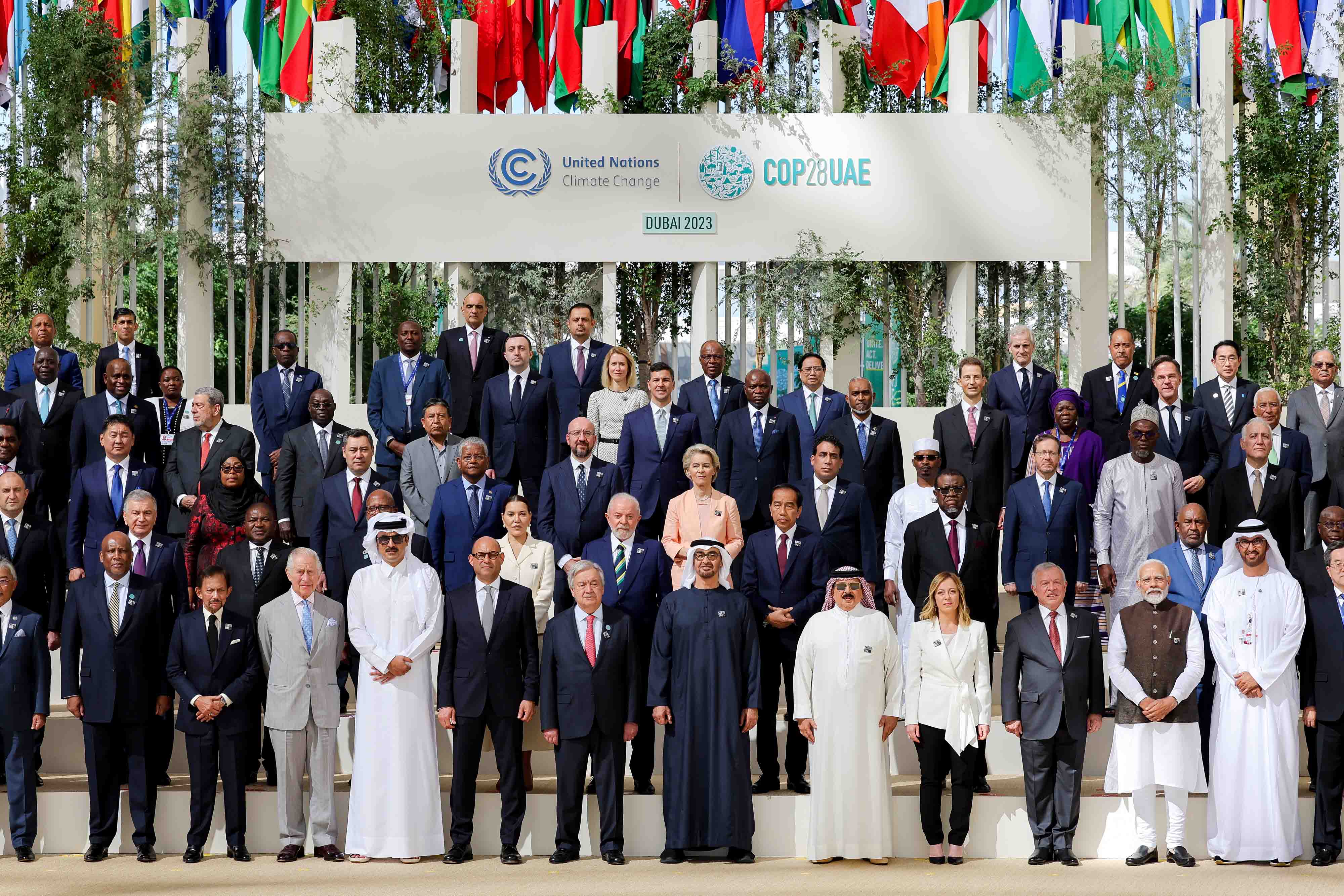

DECEMBER 1: World Heads of State pose for a group photo at Al Wasl during the UN Climate Change Conference COP28 at Expo City Dubai on December 1, 2023, in Dubai, United Arab Emirates. (Photo by COP28 / Mahmoud Khaled) As the world grapples with the escalating challenges of climate change, the urgency to find effective and equitable solutions has never been more pronounced. COP28, the 28th Conference of the Parties, stands as a pivotal moment in the global fight against climate change. Key among priorities at the summit is to increase financing for developing countries to support their climate change adaptation capacities–thus, the Loss and Damage Fund.
Mobilizing financial resources for climate action remains a critical aspect of global efforts. COP28 must address the financing gap and encourage increased investment in sustainable practices. This includes both public and private sectors contributing to projects that promote renewable energy, sustainable agriculture, and eco-friendly infrastructure.
The Loss and Damage Fund acknowledges that certain regions, particularly those least responsible for greenhouse gas emissions, face severe consequences such as rising sea levels, extreme weather events, and loss of biodiversity. COP28 recognizes the moral imperative to assist these communities in coping with and recovering from the irreparable harm inflicted by climate change.
This fund was championed by the host country UAE, which pledged $100 million to the fund. The European Union, US, UK, China, and other nations quickly followed suit, leading to a total of $700 million in pledges in just about 2 days.
Furthermore, COP28 will delve into the operational aspects of the Loss and Damage Fund, discussing transparent mechanisms for allocating resources and ensuring that funds reach the communities in greatest need. The discussions will also revolve around innovative approaches, including risk reduction strategies, insurance mechanisms, and capacity-building initiatives to empower vulnerable regions to better respond to and recover from climate-induced losses.
By addressing the Loss and Damage Fund at COP28, the international community sends a powerful message about shared responsibility and solidarity in the face of climate crisis. It is a testament to the acknowledgment that, despite concerted efforts, some losses are inevitable, and concerted global action is necessary to mitigate the impact on those who have contributed least to the climate crisis.
-


It is a chilly December 2022 night and I am in an Irish bar in Rome on Via del Plebiscito, right in the center of the city. That night, the crowd is more excited than usual and quite distinguishable. One group in particular, more than the rest. More than half of the people in the bar are either wearing blue jersey shirts with white and red stripes, or they have painted those colors on their faces. They feel it is going to be a historic night. The defending champions, France, are facing off against the tournament’s black horse, Morocco, to secure a consecutive spot in the FIFA World Cup final.
I, too, can smell history up close–but for a different reason. For the first time ever, a team from Africa can make it to the final. As I enter the bar, knowing that my friends are still on their way, I look for an opposite corner from the fans in blue, where I hope to create a crowd of Morocco’s supporters. But of course, we are in Italy and they cannot be as many as France’s. Still, I am hopeful and I can already imagine a tiny group of a dozen people taking over the massive bar at the full-time whistle. I order a drink, my friends arrive, the game starts.
Five minutes into the match, the noise in the bar is deafening. France has scored. But I remain undeterred. After all, the Atlas Lions have overcome worse odds in the tournament already. Under the euphoria of expectations, I applaud, scream, and whistle at every Morocco’s offensive action in the game. At half-time we are still one goal down, so we can still come back. Yes, we. I was Moroccan that night–for the first time in my life. My Larynx needs rest though. I order another pint of Guiness.
The second half starts. Morocco’s big names are visibly trying. Amrabat is bossing the midfield, while Hakimi and Mazroui are attacking the flanks. But the threat of Mbappe and France persists. Morocco gets its moments but France is pretty much in control. At the 79th minute, they score their second goal. The game is slipping out of Morocco’s hands. By this time, celebrations in the other corner have started. Victory tonight is theirs; they know it, I know it. The game ends, the bar’s DJ blasts Vagedream’s hit on. It’s time to go home. I bid my friends good night and I leave. But surprisingly, I am not disappointed in the loss. Instead, I am suddenly conflicted with other emotions. I am happy for a memorable footbal moment; I am proud of Morocco’s fight throughout the tournament; I am envious of French fans; I am very reflective on what football means to so many of us across the world–all at the same time.
-

In today’s fast-moving financial landscape, CPAs are expected to do more than ever manage compliance, support growing businesses, and provide trusted advisory services. The challenge? Time-consuming payroll tasks and HR paperwork can pull attention away from high-value work that clients truly depend on. That’s why more accounting professionals across the United States are turning to OnPay Payroll, a streamlined, accountant-friendly payroll platform built to help CPAs deliver exceptional service with less effort.

Why CPAs Choose OnPay
1. Designed with accountants in mind
OnPay isn’t simply a payroll tool—it’s a powerful back-office partner. The platform was created to support the way CPAs work, offering intuitive controls, client-by-client visibility, and painless collaboration. Whether you’re handling payroll for a handful of small businesses or managing large client accounts, OnPay makes it easy to work efficiently and accurately.
2. Full-service payroll that takes care of the details
OnPay automates every essential payroll task, including:
- Unlimited monthly payroll runs
- Automatic tax calculations and withholdings
- Federal, state, and local tax filings
- Direct deposit and digital paystubs
- Year-end W-2s and 1099s
By removing the administrative burden, CPAs can focus on more profitable advisory services—and spend less time dealing with payroll complexity.
3. Built-in HR tools your clients will love
Beyond payroll, OnPay includes a suite of HR features designed to simplify workforce management:
- Employee onboarding with digital forms
- Document storage and e-signatures
- PTO tracking and customizable policies
- Org charts and employee directories
With HR and payroll working together seamlessly, CPAs can confidently offer more robust services to clients—without adding to their workload.
4. Seamless integrations that make accounting easy
OnPay connects effortlessly with the tools accountants rely on, including:
- QuickBooks Online & Desktop
- Xero
- Time-tracking and benefits platforms
These integrations ensure payroll data stays accurate and up-to-date, reducing manual entry and eliminating unnecessary errors.
5. Transparent pricing and trusted support
CPAs and their clients can count on straightforward, cost-effective pricing—no hidden fees, no surprise charges. Even better, OnPay’s award-winning support team is available to help with setup, transitions, and ongoing questions. With expert guidance just a call or click away, CPAs can offer top-tier service without added stress.
Elevate Your Firm’s Payroll Offering
Whether you’re looking to streamline your internal operations or expand the value you bring to clients, OnPay Payroll is a dependable, accountant-friendly solution that empowers CPAs to modernize their services and save valuable time.
With accurate payroll, built-in HR, and powerful automation, OnPay helps your firm operate more efficiently—so you can focus on what matters most: delivering exceptional financial insight and building lasting client relationships.
-

In today’s global economy, sending money across borders is more common than ever—whether it’s supporting family abroad, paying international invoices, or planning your dream destination wedding. That’s where Xe Money Transfer comes in: a trusted, fast, and user-friendly solution that helps individuals and businesses move money internationally with confidence.
Why Choose Xe Money Transfer?
Xe isn’t just another money transfer service. It’s a globally recognized brand that has been helping people send money for over 25 years. Here’s why millions choose Xe:

✅ Competitive Exchange Rates with No Hidden Fees
Xe offers real-time exchange rates that are among the most competitive in the industry. Unlike traditional banks that often sneak in hidden fees or use poor conversion rates, Xe is transparent, giving you more value with every transaction.
✅ Fast and Secure Transfers
Need to get money across the globe quickly? Xe can deliver. Most transfers are completed within minutes to hours, and the platform uses bank-level encryption to ensure your money and data stay safe.
✅ Worldwide Reach
Send money to over 130 countries in more than 60 currencies. Whether you’re sending dollars to India, pounds to Ghana, or euros to Australia, Xe has you covered with a seamless international network.
✅ 24/7 Online and Mobile Access
Transfer money anytime, anywhere. With the Xe app, you can:
- Track real-time exchange rates
- Set rate alerts
- Send money on the go
- View your transaction history
It’s money transfer, made mobile.
✅ Trusted by Millions
Xe is part of Euronet Worldwide, a financial powerhouse trusted by millions of users and businesses globally. With millions of downloads and glowing reviews, Xe has earned its place as a leader in the currency exchange and international payments space.
How It Works
- Sign Up for Free – Create your Xe account online or via the app.
- Enter Your Transfer Details – Select the currency and destination.
- Send Your Money – Pay by bank transfer, debit card, or other supported methods.
- Track It in Real Time – Know exactly where your money is, every step of the way.
It’s that easy.
Who Should Use Xe Money Transfer?
- 🌍 Expats & Immigrants sending funds back home
- 💼 Businesses paying international suppliers or freelancers
- 💑 Couples managing cross-border finances
- 🎓 Students paying tuition or living expenses abroad
- 🏡 Property buyers making overseas real estate payments
Whether personal or professional, Xe makes every international transaction smoother, smarter, and safer.
Don’t Overpay to Send Money—Switch to Xe Today
When it comes to moving your money across borders, you deserve a service that’s fast, fair, and secure. Join millions who trust Xe Money Transfer and experience the difference for yourself.
👉 Sign up now at xe money and start sending smarter.
-

- Proven Industry Credibility
As a home-improvement–focused lender since 2002 (now part of Regions Bank), EnerBank/Regions Home Improvement Financing has funded over one million projects and billions in project value. - High Approval & No Hidden Fees
With approximately 80% approval rate and no undisclosed fees offerings include Same-as-Cash and low-interest options EnerBank stands out from alternative credit options. - Marketing Support for Contractors
Partners gain branded collateral flyers, digital banners, yard signs as well as coaching and dedicated relationship management, minimizing advertising workload. - Boosts Leads & Project Size
Contractors who promote “financing available” see substantially higher lead volume and 44% larger average project size.
📣 Key Messaging Strategies
1. Always Include “Financing Available”
Feature an easily visible callout such as badge, banner, or tagline on every marketing piece: website, truck wrap, billboard, or online ad. Research shows consumers prefer contractors that explicitly offer financing upfront.
2. Highlight Regional Bank Backing
Promote that EnerBank is backed by the robust stability of Regions Bank FDIC-insured, regional U.S.-based service, part of a long-established financial institution.
3. Emphasize Simplicity & Speed
Tell your audience how the loan is approved quickly, with paperless options via phone, mobile app, or online portal approval often in minutes.
4. Leverage Social Proof
Share real contractor-client success stories. For instance, EnerBank helped clients finance decks or solar installations without cash upfront, improving their home experience and satisfaction.

📱 Advertising Tactics That Drive Results
• Web & SEO Content
Publish blog posts titled “How to Finance Your Home Remodel” or “Upgrade Now: Easy Financing for Kitchen Renovations”. Include mention of multiple payment options Same-as-Cash, reduced interest for alignment with contractor audience.
• Digital Display & PPC Campaigns
Run Google Ads and retargeting campaigns use search terms like “home improvement loan” or “contractor financing” to attract leads ready to act. Use display banners confirming “Finance your project today Same-as-Cash available.”
• On-Site & Print Collateral
Ensure in-person marketing supports financing messaging:
- Truck wraps & yard signs: “We finance jobs—ask us how!”
- Flyers & door hangers: Use imagery and stats (“Get the full project done now—average project size up 44%.”)
- Digital banners/email templates from EnerBank’s marketing suite.
• Training for Sales Staff
Sales reps should be equipped to discuss EnerBank offerings fluently—explaining streamlined, no-fee financing backed by Regions. Leverage EnerBank’s training webinars and relationship managers .
📊 Measuring ROI & Tracking Success
Track the following to optimize advertising performance:
Metric Why It Matters Lead Volume Are more homeowners inquiring after advertising financing? Close Rate Contractors advertising financing often jump from ~25% to ~44% conversion. Average Project Size Offers of flexible payments generally increase job size by ~44% . Approval Time Faster financing = faster closings; track average time from application to disbursement. ✅ Best Practices Checklist
- Include “Financing Available” prominently across all marketing channels
- Tailor messaging to highlight Same-as-Cash and low-interest plan options
- Use contractor-branded collateral provided by
EnerBank - Train sales staff on quick, transparent loan presentations
- Collect customer stories to use as powerful testimonials
- Monitor lead conversions and ROI to continually refine ads
🔚 Summary
Advertising Regions EnerBank is a smart move for contractors and home-improvement marketers. With powerful attributes such as trusted bank backing, turnkey marketing assets, paperless quick approvals, and data-backed projection growthit’s a compelling value proposition. By weaving financing messaging into all your outreach, you differentiate your business, grow sales, and drive larger, more profitable projects.
- Proven Industry Credibility
-

In today’s world, security is not just a necessity; it’s a priority. As more people seek peace of mind, the demand for effective home security solutions continues to grow. Verisure, a leading European provider of smart security systems, has established itself as a trusted brand in the industry, offering advanced security technology for homes and businesses. For marketers and advertisers, this presents a significant opportunity to leverage a product that speaks to universal concerns—safety and protection.
Whether you’re a seasoned digital advertiser or just getting started, this guide will walk you through the best strategies to effectively advertise Verisure and drive real engagement, conversions, and revenue.

Why Verisure is the Perfect Product for Advertising
Before diving into advertising strategies, it’s essential to understand why Verisure stands out in the competitive home security market:
- Reputation and Trust:
Verisure has built a strong reputation as a reliable and innovative security service provider, with over 4 million customers across Europe. Its reputation provides advertisers with a solid foundation of trust that can help drive higher conversion rates. - High-Value Offering:
Home security systems are high-ticket products, and the potential for substantial revenue is clear. With an emphasis on long-term subscription models and premium equipment, Verisure provides an excellent opportunity for both affiliate marketers and direct advertisers to earn significant commissions. - Comprehensive Range of Products:
Verisure offers a wide variety of security solutions, including alarm systems, surveillance cameras, smart home integration, and 24/7 monitoring services. This diversity ensures that it appeals to a broad audience, making it a great fit for various advertising formats. - Growing Market:
The demand for home security systems continues to increase, driven by the rise of smart homes, increased awareness of safety issues, and a general desire for more control over personal security. This growing market means that there is always an audience looking for security solutions.
Best Strategies for Advertising Verisure
Now that we’ve established why Verisure is a prime product to advertise, let’s look at some of the best strategies for reaching your target audience and converting them into loyal customers.
1. Content Marketing and Educational Campaigns
Content marketing remains one of the most effective ways to engage an audience. When it comes to home security, educating potential customers about the benefits of investing in a smart security system is key. Verisure offers several avenues for creating informative and valuable content:
- Blog Posts and Articles:
Write detailed articles that answer common questions, such as “Why is home security important?” or “What are the best features of a smart alarm system?” Providing actionable tips and expert insights will build trust with your readers and position Verisure as the go-to solution. - Case Studies and Success Stories:
Showcasing real-life success stories of Verisure customers who have used the service to prevent break-ins or improve their security systems can be incredibly persuasive. People love stories they can relate to, and success stories can foster an emotional connection to the brand. - Infographics:
Create shareable infographics that highlight alarming statistics about home burglaries, the benefits of having a security system, or comparisons between Verisure and other security services. Visual content tends to attract more engagement, making this a powerful way to advertise. - How-to Guides:
Create guides that educate users on how to install or use smart security systems. While Verisure handles installation, these guides can still be helpful in explaining the technology behind the systems, boosting your credibility as an authority in the space.
2. Influencer and Affiliate Marketing
Influencer marketing continues to be one of the most successful ways to drive brand awareness and conversions, especially in the home and lifestyle categories.
- Home Improvement Influencers:
Partner with influencers in the home improvement, DIY, or tech space who already have a strong following. These influencers can review Verisure products, demonstrate their features, and provide personal testimonials about their effectiveness. Influencers have the ability to engage their audiences with authentic content that is likely to drive action. - Affiliate Marketing Programs:
Verisure has attractive affiliate programs that allow publishers and marketers to earn commissions on sales generated through their unique links. If you run a website, blog, or social media platform, promoting Verisure through an affiliate marketing program could be a highly profitable strategy. Focus on targeting relevant keywords and creating high-converting content that leads to sales.
3. Targeted Digital Advertising
For advertisers looking to drive immediate results, digital advertising offers a great way to reach a broad audience. Verisure’s products appeal to homeowners, renters, and even businesses, so targeting campaigns effectively will be key to maximizing conversions.
- Google Ads (Search & Display):
Google’s search ads allow you to capture the attention of users who are actively searching for home security solutions. Use targeted keywords like “best home security system” or “smart alarms for home” to drive traffic. Display ads on relevant websites can also help increase brand visibility and awareness. - Social Media Advertising:
Social platforms like Facebook, Instagram, and YouTube offer robust targeting options that allow advertisers to zero in on individuals who are most likely to be interested in Verisure’s products. For example, you can target users based on age, location, interests (such as home improvement or tech), and even behaviors like purchasing home electronics. Dynamic retargeting ads can also help bring back visitors who didn’t convert on their first visit. - YouTube Ads:
Video advertising is an excellent way to showcase Verisure’s products in action. Creating short explainer videos or even customer testimonials can be highly effective on platforms like YouTube. These videos can drive both brand awareness and direct conversions.
4. Leveraging Seasonal Promotions and Discounts
Special promotions are a powerful tool in the advertising arsenal. Offering seasonal discounts or limited-time offers can create a sense of urgency, motivating customers to take action quickly.
- Black Friday / Cyber Monday:
Offer discounts or bundled deals around peak shopping periods like Black Friday or Cyber Monday. These are times when consumers are already in “buying mode,” and advertising Verisure with attractive offers will help increase conversion rates. - End-of-Year Sales:
Offer deals at the end of the year, especially in conjunction with New Year’s resolutions. Many people think about home improvements as part of their yearly goals, and a home security system can be positioned as an essential upgrade.
5. Local Advertising and Geo-Targeting
Verisure operates in several countries, so geo-targeting your ads can help ensure you are reaching the right customers in the right regions.
- Localized Content:
Create content that speaks directly to the security concerns of specific regions. For example, if you’re advertising Verisure in a city with high crime rates, emphasize how Verisure can provide peace of mind in high-risk areas. - Google Local Campaigns:
Google’s local campaigns allow you to target users based on their geographic location. You can use location extensions to drive foot traffic to physical Verisure stores or to target users looking for home security solutions in your region.
6. Email Marketing Campaigns
Email marketing remains one of the highest-converting digital marketing channels. Build an email list through content offers or lead magnets, and nurture leads with valuable information about home security.
- Segmentation:
Use segmentation to send personalized emails to subscribers based on their behavior or demographic information. For example, new homeowners may benefit from educational content about the importance of home security, while previous customers may be interested in upgrading to newer devices. - Newsletters:
A well-designed newsletter featuring tips on home security, new product launches, and seasonal promotions can keep your audience engaged and informed about Verisure’s offerings.
Conclusion: Making the Most of Advertising Verisure
Advertising Verisure is not just about selling a product; it’s about selling peace of mind. Home security is a concern for many, and by advertising Verisure, you are offering a trusted solution to a problem that affects people on a personal level.
By employing a combination of content marketing, influencer partnerships, digital advertising, and seasonal promotions, you can successfully advertise Verisure and drive significant conversions. Whether you’re leveraging affiliate marketing or running targeted digital ad campaigns, the opportunities are vast.
With the growing demand for smart home solutions, now is the perfect time to get started with advertising Verisure. Take the first step today and unlock the power of one of Europe’s leading security brands.
- Reputation and Trust:
-

Maximize Your Revenue with High-Converting Financial Offers
In the competitive world of affiliate marketing, finding a reliable partner with top-tier offers, exceptional payouts, and scalable opportunities is critical. Enter Echo Trade CPA/CPL – US – the next-generation affiliate program that’s changing the game for marketers targeting the U.S. financial space.
Whether you’re a seasoned affiliate or new to performance marketing, Echo Trade offers an unbeatable combination of premium financial offers, fast-tracked payments, and high-conversion landing pages designed to help you earn more, faster.

💼 What Is Echo Trade?
Echo Trade is a cutting-edge affiliate program specializing in Cost Per Action (CPA) and Cost Per Lead (CPL) campaigns tailored to the U.S. market. With a strong focus on the finance, investment, and trading verticals, Echo Trade connects high-intent users with world-class financial platforms and services.
🚀 Why Affiliates Choose Echo Trade CPA/CPL – US
🔹 Competitive Payouts
Get rewarded generously for every qualified lead or action. Echo Trade offers some of the highest CPA/CPL rates in the financial affiliate space, ensuring you get the best return on your traffic.
🔹 Top-Performing Offers
From forex trading platforms to financial education and investment services, Echo Trade provides access to top-converting offers that are fully optimized for U.S. traffic.
🔹 Real-Time Tracking & Analytics
With Echo Trade’s intuitive dashboard, you get real-time tracking, conversion insights, and performance metrics to optimize your campaigns with precision.
🔹 Fast Payments
Time is money. That’s why Echo Trade ensures on-time payouts via multiple secure payment options weekly, bi-weekly, or monthly.
🔹 Dedicated Affiliate Support
Your success is Echo Trade’s priority. Enjoy 24/7 affiliate support from industry professionals ready to help you scale, troubleshoot, and grow your campaigns.
📈 Ideal for All Traffic Types
Echo Trade CPA/CPL campaigns perform exceptionally well across:
- Email marketing
- Native and display ads
- SEO and content marketing
- Influencer campaigns
- Paid search and social ads
Whether you’re targeting beginners curious about investing or seasoned traders looking for new tools, Echo Trade’s offers match intent with value, delivering consistent results.
🏆 Partner with a Platform That Converts
Echo Trade isn’t just another affiliate network it’s a performance engine built by marketers, for marketers. With proprietary tracking tech, razor-sharp creatives, and unbeatable EPCs (Earnings Per Click), it’s no wonder top affiliates are making the switch.
💬 Hear from Our Affiliates
“Echo Trade has completely transformed my affiliate strategy. The offers convert better than anything I’ve run, and support is always a message away.” – Michael T., Affiliate Marketer
“Solid payouts, no drama, and fast payments. Echo Trade is the real deal for anyone in finance traffic.” – Andrea M., PPC Specialist
🎯 Ready to Monetize Your Traffic?
Don’t leave revenue on the table. Join the growing number of affiliates earning big with Echo Trade CPA/CPL – US.
👉 Sign up today and start earning smarter.
📍 Target Region: United States
💰 Model: CPA / CPL
🔗 [Join Now] (click here link) -

If you’re still thinking TikTok is just for dancing teens think again.
In 2025, TikTok has taken over as the #1 entertainment platform in the U.S., with millions of users watching, creating, and sharing content every single day. From trending comedy and beauty tips to viral product hacks and breaking news, TikTok is where the internet lives now.
Whether you’re a creator, a scroller, or just bored on your lunch break TikTok is the ultimate way to stay entertained, informed, and inspired.
📲 Why TikTok Is a Must-Have App in 2025
Here’s what makes TikTok the most downloaded app in the U.S. today:
🚀 Feature 💥 Why It’s Addictive Endless Personalized Feed Discover content you love with TikTok’s AI-powered algorithm Short, Snackable Videos Entertainment that fits in any moment scroll, laugh, repeat Every Niche Covered Beauty, fitness, gaming, food, tech, comedy, life hacks you name it Go Viral Overnight Anyone can become the next trending star,no followers needed Free to Use. Always. No hidden fees, no subscriptions, just pure scroll-worthy fun 🎉 What You’ll Find on TikTok
- 🤣 Hilarious skits and meme culture
- 💡 Life hacks you didn’t know you needed
- 🧠 Educational content that actually sticks
- 🎨 Creative inspiration from millions of users
- 💬 Raw, relatable stories and real-time trends
- 📦 Product reviews that drive what’s hot on Amazon and beyond
💬 What Users Are Saying
“I downloaded TikTok for fun—now I learn more from it than YouTube or Instagram.”
— Samantha, 28, Texas“It’s the only app that makes me laugh, learn, and connect—all in 10 minutes a day.”
— Marcus, 35, California“I grew my business and my following just by posting TikToks. The reach is insane.”
— Natalie, 24, NYC🚀 Why You Should Download TikTok Now
Whether you want to be entertained, educated, or go viral TikTok gives you the tools to do it all, straight from your phone.
✅ Free to download
✅ Watch instantly no account needed
✅ Tailored content from the moment you open the app
✅ Millions of creators, stories, and trends to explore🎯 Final Word: TikTok Is More Than Just an App It’s a Movement
If you’re not on TikTok, you’re missing out on what’s shaping culture in real time.
Don’t just hear about trends be part of them.
👇 Click here to download TikTok now and start exploring (link)
Free. Fast. Fun. And way too addictive.